Pest identification guide
Termites in South Florida: Identification Guide
Drywood or subterranean? How to read pellets, mud tubes and swarmers in South Florida. An identification guide only.
South Florida has several termite species, and knowing the signs helps you act quickly. These pages are for identification and education only. Pro-Spray doesn't treat termites.
Swarmers or Flying Ants?
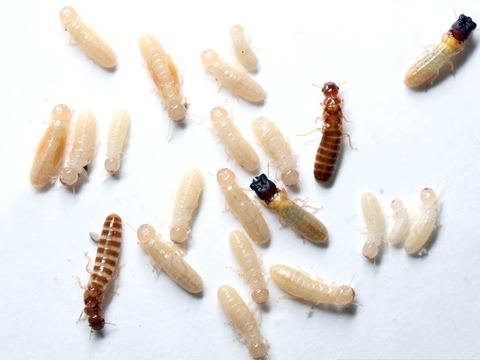
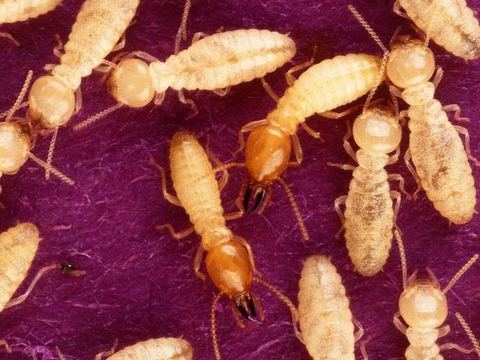
Termite swarmers have straight antennae, a broad waist and two pairs of equal-length wings. Flying ants have elbowed antennae, a pinched waist and front wings longer than the hind wings. See our ant guides, including Florida carpenter ants and rover ants.
Termites through the South Florida year
Most people first notice termites when the winged swarmers appear, and in South Florida that can happen from late winter into summer. Asian subterranean termites often swarm on early spring evenings. A drywood colony grows slowly and can take a few years to get big enough to swarm, so the first swarmers often mean the colony has been there a while. Formosan subterranean termites swarm at dusk from about late April into June and gather in large numbers around porch lights and lit windows. Eastern subterranean termites are the exception: they swarm during the day, often on a warm morning after rain in late winter or spring. Drywood termites send out smaller swarms on spring and summer evenings, and they're drawn to lights too. Swarmers lose their wings within minutes of landing, so a pile of wings on a windowsill is often the only thing left behind. Between swarms, the clues are quieter: small pellets under furniture or a window frame, mud tubes running up a foundation wall, or paint that bubbles over wood that sounds hollow when you tap it.
Which one is it?
| Small six-sided pellets in a little pile | Drywood termites pushing waste out of the wood | Under furniture, window frames, baseboards, attic wood |
|---|---|---|
| Pencil-width mud tubes | Subterranean termites traveling from the soil | Foundation walls, slab cracks, garage walls, inside cabinets |
| Piles of wings, all the same length | A termite swarm has already happened | Windowsills, light fixtures, spider webs near doors |
| Winged insects with elbowed antennae and a pinched waist | Flying ants, not termites | Near lights after rain, along baseboards |
| A daytime swarm in late winter or spring | Often eastern subterranean termites | Near the slab, patios, mulch and woodpiles |
Who to call about termites
Pro-Spray doesn't treat termites. Our license covers household pests and rodents, not termites, so we don't inspect for termites, treat them or tent homes. If you think you have termites, contact a company licensed in Florida for termite control, which the state calls wood-destroying organism (WDO) work. If you aren't sure what you're seeing, your UF/IFAS county Extension office can help identify a sample. Save a few swarmers or pellets in a sealed bag or a jar so they can take a look.
Frequently Asked Questions
Does Pro-Spray treat termites?
Does a swarm inside the house mean I have termites?
Is it termites or flying ants?
Questions? Call or text anytime.
Questions about a pest in or around your home? Call or text us.